



An Interview with Micelf
By Caroline Tanner
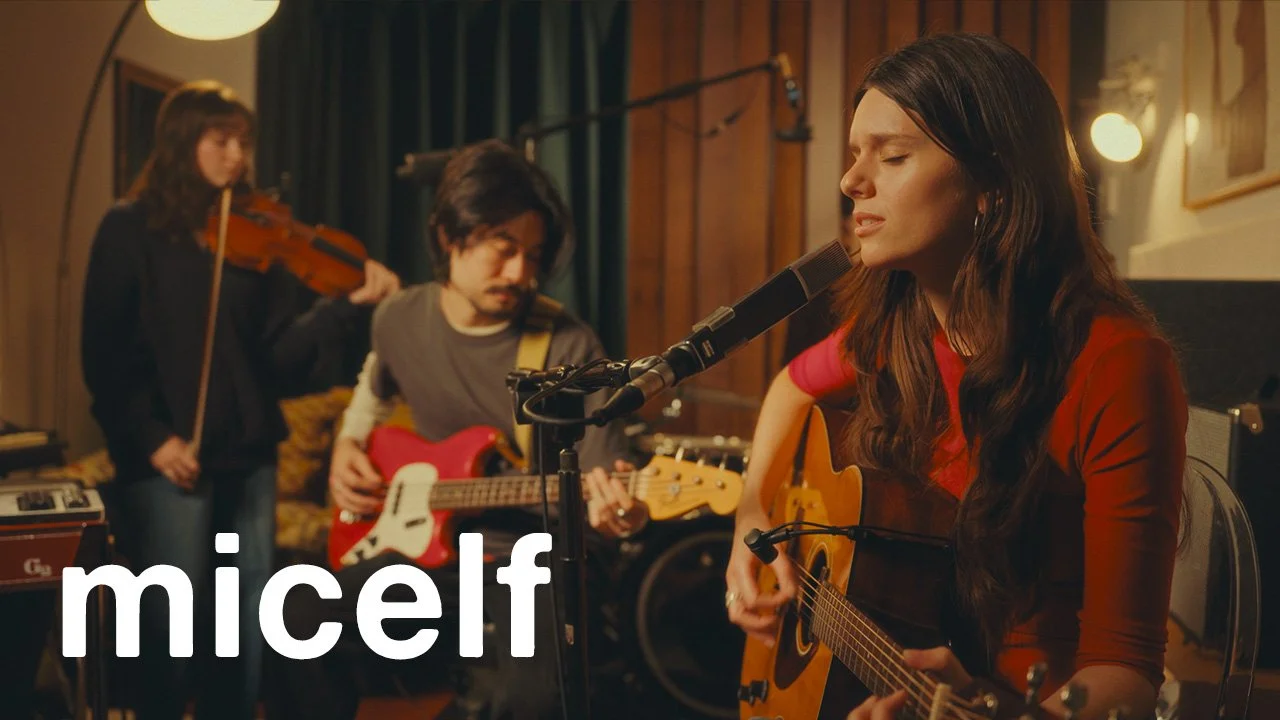
In her sparsely furnished New York apartment, I sat down with Ciara Sophia Rudas, the artist behind micelf (pronounced “myself”). What unfolded was a conversation about cycles—seasonal, creative, biological. The process and project of documenting the changing self over time. Ciara speaks about her work with a mix of abandon and care, describing her songs as “children” that emerge uncontrollably when allowed room to grow, yet require nurturing to exist outside of her.
Our conversation moved fluidly between the practical and the ephemeral, solitude and collaboration, the importance of giving oneself permission to create. We played show and tell, ate cheese and crackers, drank hibiscus tea, made plans to go dancing. We talked about our attachment to our hair, the idea of shaving it all off, the relentless pull of different artistic disciplines, and the release of her second EP, For You. Ciara sent me on my way with a granola bar and I spent the rest of the day humming her song, “Vomit.”
__________________
CIARA: Sorry the place is so spare, but I cleaned for you. I hate when you walk into someone's apartment and the bathroom is disgusting, so we cleaned it for you.
CAROLINE: This is a really beautiful space and I definitely appreciate the cleaning.
CIARA: Both my partner and I have been in these pretty gnarly sprints of creativity, which is awesome, but it means the Facebook Marketplace hunt has fallen to the back burner. I actually think it’s nice to be able to look out at a blank wall though. It’s important for a mind that's chaotic.
CAROLINE: Tell me about your sprint of creativity.
CIARA: I get in these cycles where I don't want to do anything, and I hate my voice, and I hate the songs. But then I'll invite some sort of catalyst into my life, for me to get back on the horse, and when that happens and I'm in momentum, I'm like a boulder. I just keep rolling. Like with For You, I recorded it last March in LA and I was really lagging on mixing it and mastering it, but then I had a friend that asked if I wanted to play a show with her and that made me get all my ducks in a row. There's kind of this funny business woman hat you have to wear in any creative expression that's up for public consumption or purchase.
CAROLINE: It’s a necessary version of yourself.
CIARA: Yeah, and it can be really heavy and gross, but this is the price of admission to pursuing art. Not all art makes it out of your brain if you don't allow it to, and then not all art makes it out of your studio. And that's totally cool and fair, but I think that the pieces that jump out to you and need to go out and be released—you have to then be a big supporter of that. It's like a child. It's like you grow this thing, you incubate it. So that kind of parenting was all I did this winter, and it was my first real winter ever. I was born on Maui and grew up south of LA, went up to Santa Cruz, and then lived in LA until last year. So it's been all easy, warm, timeless years. I think everyone was worried about me, that I would freeze when I moved to New York, but I loved it. I fucking loved it. It reminded me of early COVID when you had to just be alone with yourself. I love being alone with myself. The winter lets you get into the cave of your soul, and I loved it.
CAROLINE: I also really love being alone with myself, probably sometimes to a fault. Winter is just such a good excuse to just be alone and work on the projects that I wanna work on and I love that, you know?
CIARA: Yeah, totally. And writing is your primary output?
CAROLINE: Writing and music, but I never really considered myself a writer before I came to New York and NYU, until a professor left a comment on an essay I wrote. He said something along the lines of “you know you were a real writer, right?” and it really changed something in me.
CIARA: That's so rad. To be seen in a way that you haven't seen yourself. It’s like a push up. I want to read your writing.
CAROLINE: I’ll send you some.
CIARA: My partner is a poet, and he hosts this poetry night monthly. Super casual, really intimate, usually less than 40 people, which is kind of perfect. We had one two weeks ago, and it was the best one yet. People just get up and read, and I read sometimes, or I'll sing a cappella if there’s a song that feels like a poem to me. I guess all songs are poems. Wait, no—let me rephrase that.
CAROLINE: I was just about to say I love that you brought that up and I don't think they are.
CIARA: I don't think they are either. They both need rhythm, but there's something really satisfying about pairing words to a melody. The melody usually takes precedence for me in terms of the feeling of the song, and then the words bolster that, so if I try to read the song without melody, it feels so flat. It can almost be kind of trite because there are a lot of rhyming patterns and repeats, so it’s too clean. I've tried to read my songs and I actually lose my place because I don't know my own work without it being in the context of the melody.
CAROLINE: Will you tell me about the last song you wrote?
CIARA: I actually wrote a song this morning. They come to me whenever, there's really no process. I have this one Google Doc that I've been keeping for 12 years at this point, and anytime I have a song idea I write it in there. So sometimes I'll play through that and go from there, but yesterday I was kind of having a bad day, and I just started hammering on the guitar to hear something and I found a nice melody. Then this morning I found a little vocal line, but it's pretty rare that it goes that way. Lyrics usually come when I'm walking or driving or washing dishes or in the shower. That's the hypnotic state.
CAROLINE: The mundane behaviors, yeah. When the body’s occupied in a way that doesn't require you to think about what you’re doing, the mind can go.
CIARA: And that's when your subconscious pulls things out of you. I'll get these lines, and then I get my guitar, open my little Google Doc, and then see what happens. Sometimes I get the songs like years apart, like the bridge won't come until 5 years later, which is totally fine. I think in this world of quantity, that quality is really important, and that's such a subjective thing. Quantity is not subjective, and so, there's this feeling that, if I allow myself to be a channel with a radio antenna up to receive, then I'm fine with the timing. I often dream songs, and I'll wake up in the middle of the night and try to voice memo them. Sometimes they’re really bad and incoherent when I listen back and I crack the fuck up. What about you? How do you write?
CAROLINE: A lot of what I do for school is listen to the sounds of sentences and the way that words sound when they're put next to each other, so a bunch of my songs have come from things that I hear in my day that I then write down in this little notebook I’ve started carrying around. Then I'll mess around on the guitar and find a progression I like and then put the lyric to a melody. But sometimes I’ll start with a chord progression and word vomit on top of that.
CIARA: Do you often find that your subconscious speaks through those word vomits?
CAROLINE: Yeah, definitely. I wrote this one song called “Open House” after having a really terrible, almost breakup fight with my ex. It’s about this couple that lives together and when they split up, one is left with the apartment and only the spoons because the other one took the forks. At the end of it, the one that stayed moves out, and there's an open house. We broke up not long after that, and I guess I was thinking a lot about what I might be left with, you know, if we did, and what he would take away. So then it made sense, after the relationship ended, that that's where it came from.
CIARA: That's so cool. I think there's a lot of very important and precious storytelling that we do for our own peace of mind without even knowing it.
CAROLINE: Tell me more about your writing, maybe one of the songs off For You? Actually, on vomit, tell me about “V omit.” I love it. I love it so much. It’s so stuck in my head, I was whistling it on the doorstep when I got here.
CIARA: Yeah, that song bangs. I love that song. When I broke up with my current boyfriend I spent three days in my room, really just subsisting on cheese and crackers. It's so funny, whenever I'm traveling alone or I'm separated from my partner because they're traveling, I get this really, really great sense of strength in myself. I eat better, I exercise, I'm a great friend and a great daughter. I'm just a really solid ass person, and that’s where I was trying to go in the song. I thought, alright, buckle up, buttercup—you're gonna have to put your big girl pants on and move through this thing you thought was going to be forever and, by your own volition, is done. Now we're skating toward something that is wholly unknown and neither of us has control.
CAROLINE: I feel like we need to backtrack and hit some of the basics. This is great though. Okay, tell me about the name of your project, micelf.
CIARA: Okay, micelf. I wanted to use my name, but I felt like it was so utterly feminine.
CAROLINE: What's your full name?
CIARA: Ciara Sophia Rudas. I love my name, but I think I didn't want to be seen fully when I chose micelf. I know that now, but then I thought I was being cheeky, like, it’s me, it's micelf. Eventually, I'll put music out under my name, but it’s served me well.
CAROLINE: What’s your musical background? Where did you start?
CIARA: I’ve always been a singer. When I was two, my mom's friend suggested that my mom, who had no cash, put me into singing lessons to wrangle my voice early, which is kind of crazy to think about.
CAROLINE: You sang before you really had words.
CIARA: It might have been at three, but it was before we moved off Maui, so my mom would drive me to the other side of the island for these lessons. And then my dad and my stepdad both played guitar, and so when I was eight, my dad taught me “Blackbird,” and a couple of classical Spanish, easy finger picking songs.
CAROLINE: Tell me about the first song you wrote.
CIARA: Funny, funny times. When I was 18, I went to a show and saw my boyfriend at the time there with his ex-girlfriend, and that was really shocking, so I went home and I wrote this song about it, and then the floodgates opened and songs just poured out of me left and right, as if I had been saving them. I recorded a little album in my mom's bathroom, burned a bunch of CDs and played one show, and that was it until I recorded again at 25. After that show I didn't want to give my work out to the world. It really scared me, but the first song was such a great starting point.
CAROLINE: So how has your writing changed since that first song?
CIARA: A lot of the early songs were in reaction to an event—that was my whole first EP and a lot of my second EP, but in recent years I’ve been writing so much more about myself and my future self, about that gap between her and I. It's been more of a practice of pulling that out, because that idea isn’t as tangible as the facts of an event. The songs are almost like prayers or manifestations in a way, to shoot a trajectory forward. It feels like I’m back in that freaky middle school period—you know that jump from childhood to high school. I guess that's my best way of describing the late 20s, where you’re looking at everything in your life and grading it, and being a hater. I feel like I went through a crazy hater phase a year ago, but I let myself go through it knowing I just needed to create an exhaustive list of what needed to go. I was seeing all these cracks in the facade and thought, how the fuck am I gonna repair this all at once? I had to sit in that for a while, and I realized I don't really have a lot of control over timing, but if I've already planted the seed in my mind of where I want to go, it’ll naturally open for me. There’s a trust there, that once you identify that desire, you can find the resources or will inside of yourself to then move.
CAROLINE: How does that relate to your music?
CIARA: It’s that parent to child relationship. Those two forces are living with me, and so I think a lot of my writing is me trying to push myself forward, while also having to manage the output side, without it feeling like it’s an egotistical or self-centered act. That's what a lot of artistic expression is—it's you mining yourself, and it's all restorative. I think it lifts you, and so I feel like I’m the parent of the child that is these songs, pushing it along.
CAROLINE: You said that there was a long period where you didn't share your music. What made you want to start again?
CIARA: Great question. I had a psychedelic experience that wasn’t with substance, it was context. There's an indigenous sweat lodge experience that happens in Mexico called a Temascal. And when my ex-partner and I were breaking up, we went to Oaxaca on a separation trip because that's where we had started our relationship. We crawled into this oven, basically, it was maybe five foot by five foot. There was a wood burning fire in the corner, so it was like 100 and whatever the fuck degrees. We crawled in through this tiny door naked, and there was a woman in there with herbs, doing her process to cleanse us. I had no idea what I was going into and I thought it was gonna be so relaxing.
CAROLINE: No, no, you're in such physical discomfort. I’ve done a sweat lodge before and it was also so cathartic but I thought I was gonna die the entire time.
CIARA: I thought I was gonna die too. I had this thought that even though my body is so weak here, my soul persists. I felt like I could see my little soul in the darkness of the universe and of the galaxy. I was this little orb, and there was nothing that I could do for my partner to alleviate his discomfort and there was nothing he could do for me, so that’s when we realized, this is the end of our relationship. I realized, I am whole, just me, and I won't always be me this way, so let me now approach my life now knowing the things I want to do. So we crawled out and I thought, I'm gonna record my songs now. It's funny—that whole relationship, I didn't release anything, and I met him right after I put out that first collection of music. I wrote for the seven years we were together, and then when we broke up, I was ready to put it out.
CAROLINE: Awesome. Has that shown up in your writing?
CIARA: Not as much as I would think. It was more of a selfhood thing. The writing, the music aren’t my whole life. I feel like a jack of all trades, master of none. I've investigated so many career paths and tried my hand at a bunch of different mediums, but nothing is ever completely satisfying for me. I'll pick something up for a time and then be done with it, like I used to be a professional chef but now I never want to cook again. I've been upset about that in the past, and it made me question, am I an actual artist? Am I a musician? I think I'm more aligned with artist than musician as a label. Music is one piece of the pie, but I have a really critical, analytical, organizational brain, and there are mediums that scratch that itch way more than music.
CAROLINE: What else inspires your music and your writing, or I guess any of your creative practices?
CIARA: There’s always this feeling that needs to be explored and properly put into words. I’m really good at speaking through my feelings and rationalizing them and dissecting them and organizing them. Like maybe I'm feeling really angry right now but instead of feeling the anger, I'm more so observing it—but sometimes I just want to be fucking angry, and I think that's the realm that the songs occupy. They get to be raw. They can start true and then they can morph, and that’s where the storytelling comes in, which is why I can totally understand how you evolved into becoming a writer. Sometimes songs feel kind of limiting in that way, when they're meant to fit into a certain form. I want them to be free and messy, but then when I record I feel like I get demoitis, where I'm like, this demo is perfect—it's lo-fi enough to where all of mymistakes are excusable. I think what freaks me out about hi-fi is that everyone could see that I'm a phony, or everyone's gonna hear the couple missed notes, and that the breath isn’t supported on this line, and this is super nasally, or whatever the fuck, and I'm gonna be exposed. I mean the first EP, right—choosing to use micelf instead of my name, doubling vocals on every single track, those are hiding places. With the EP I just released, I really wanted to be honest. I want to be a human, and I know the mistakes I hear are not actually audible to anyone else.
CAROLINE: I think about this all the time in my own work. People who are more attuned to listening to music might hear those small mistakes, but that is maybe 10% of the population.
CIARA: Is that a real number?
CAROLINE: No, that's completely fabricated, but you know what I mean.
CIARA: I was gonna put that into my little database.
CAROLINE: We can pretend it’s real, but most people aren’t gonna hear the tiny mistakesbecause they just don't know they're mistakes.
CIARA: Totally. And in our brain we can hear the way we ideally want to say something, but no one else has that point of reference. No one has a cheat sheet that's like, “ooh yeah. That sounded like shit, and I know how she wanted to do it, but she actually couldn't, and therefore she sucks.”
CAROLINE: Exactly. No one knows the way it is isn’t the way you wanted it to be.
CIARA: That’s great. I’m gonna remember that 10%.
CAROLINE: Do it. What do you want people to take away from your writing or from your music?
CIARA: I hope it's a connection point. It’s an opening, if they choose to take it. Once it’s out there it's no longer mine, really. I keep referring to the songs as children. When they leave your care, they're gonna touch people and make connections with people that you will never know. Some people are gonna end up hating them for whatever reason and it's not up to me, but I would hope that they could be a companion to someone. I’m so inspired by my friends who are artists, just for doing it, and I hope people feel that way about me. I can go to a museum and not love a painting that's in front of me, but I respect that somebody did the thing and gave it out to me. So the connection is important, but I think it’s also the ability. If I can get beyond my ego or my inner critic and put this out feeling like there are mistakes in it, then anyone else can. I think you kind of see that at shows when you play, there's this feeling of awe and you're just proud of them and you're looking at them and you're thinking, I can't believe you were a child at one point and now you're doing this. The best is when you can see someone's child in them. I feel like you can always see the child in someone who's so engrossed in what they're doing. Sometimes when I'm performing, I see these faces that I'm reading and hoping I’m giving them that bolster so they think they can do it too.
CAROLINE: Will you tell me more about that? Maybe one or two affirming moments in your musical career? You said earlier that it's not your whole life, but moments when you've really felt that the music is a real part of yourself.
CIARA: It's hard because the mind immediately goes to moments of praise, which is short-lived, you know, and it's subjective. I think it’s that when you write a song it's like writing a script for someone else to read, in terms of hiring bandmates. Whenever someone says, yeah, I would love to play with you, I think, you get down with my message? You're comfortable sharing in this message and amplifying it with me? And that is the best feeling—being in relationship with other artists and my work being the group project.
CAROLINE: The glue that binds.
CIARA: Yeah, like right before I left LA I cut a ton of demos for what I'm learning is gonna be an album. Not that it's against my will, but there's now all this interest from friends and collaborators that really drives me forward. I wrote a song with my co-producer, sound engineer, and bassist, Jack Carek, that I really like, and it's been stuck in my head. He asked me to play him all of my new songs, and he said “oh, this is your album. Eight songs? You got any more?” The trust that he sees them as viable, tenable songs is enough for me to get on the cart that he's started pushing. But first I have to go get my nose fixed.
CAROLINE: What?
CIARA: I can't breathe through my nose, really. I have a couple things going on in there. A deviated septum, and then also these turbinates like on the sides that I have to go get cauterized and pushed back, and then I have to heal from that.
CAROLINE: Damn. I need to get my nose cauterized too. I get terrible bloody noses, almost every day in the winter.
CIARA: But your apartment's probably dry from the radiator, right?
CAROLINE: Yeah, but I get them with a humidifier too. I even put Vaseline on a Q-tip and stick it around my nose but it doesn't help.
CIARA: Fuck man. Our noses.
CAROLINE: It sucks.
CIARA: I’ve breathed like a pug my whole life and I think it's really affected my singing and my like oxygen flow to my fucking brain. Even just walking I'm huffing and puffing. So I'm gonna go get my shit fixed next week and then once that’s healed, I’m gonna record.
CAROLINE: Well I’m excited for you. For the nose stuff and the music stuff. I'm excited to see what you do.
CIARA: I want to put out art for the rest of my life. It might not always be through the medium of song, but I have to give it all a chance.
CAROLINE: Me too. Thanks so much for your time, this has been really, really lovely.
CIARA: Really lovely. Let me get you a snack for the road. I think you need some sugar.